Threat Modeling OpenAI, RAG & Agentic Workflows
How NodeMotion models LLMs, vector stores, and MCP tool-calling agents under STRIDE + MITRE ATLAS (NM-ATLAS-LLM01), and how AI Safety Guardrail & DLP mitigate prompt injection.
“In Agentic AI, untrusted text isn't just data—it's an uncompiled program trying to hijack your MCP tools.”
Never allow an LLM orchestrator to invoke external MCP tools directly without schema integrity pinning.
Verifies SHA-256 tool manifests (blocking AML.T0110 rug pulls) and pauses destructive writes for human approval.
Must receive user-scoped OAuth 2.0 On-Behalf-Of tokens over mTLS rather than using a shared admin credential.
1. MCP (Model Context Protocol) Threat Modeling
Model Context Protocol (MCP) introduces a 3-tier execution plane: MCP Host (IDE / Agent Orchestrator) → MCP Client (JSON-RPC session manager) → MCP Server (local stdio or remote SSE/HTTP tool bridge). When you import a repository containing .mcp/config.json or mcp.json via File → Import IaC / Spec, NodeMotion automatically synthesizes MCP Host / AI Agent, MCP Server, and Vector Store (RAG) nodes and flags cross-boundary threats.
{
  "mcpServers": {
    "qdrant_rag_mcp": {
      "command": "npx",
      "args": ["-y", "@modelcontextprotocol/server-qdrant"],
      "url": "https://mcp.internal.corp/sse"
    },
    "postgres_orders_mcp": {
      "command": "uvx",
      "args": ["mcp-server-postgres", "--read-only"]
    }
  }
}Dynamic or unpinned MCP servers mutate tool JSON schemas/descriptions after approval, smuggling hidden prompt instructions. 1-Click Fix: Splice an inline MCP Policy & Schema-Pinning Proxy (mcp_proxy).
Shadow tool parameters exfiltrate conversation history or local .env files over outbound tool payloads. 1-Click Fix: Enforce DLP redaction and default-deny egress proxy.
An MCP server uses its own shared admin token against downstream DBs/APIs instead of the caller's user-scoped OAuth 2.0 On-Behalf-Of token. 1-Click Fix: Upgrade hop to mTLS + OIDC token exchange.
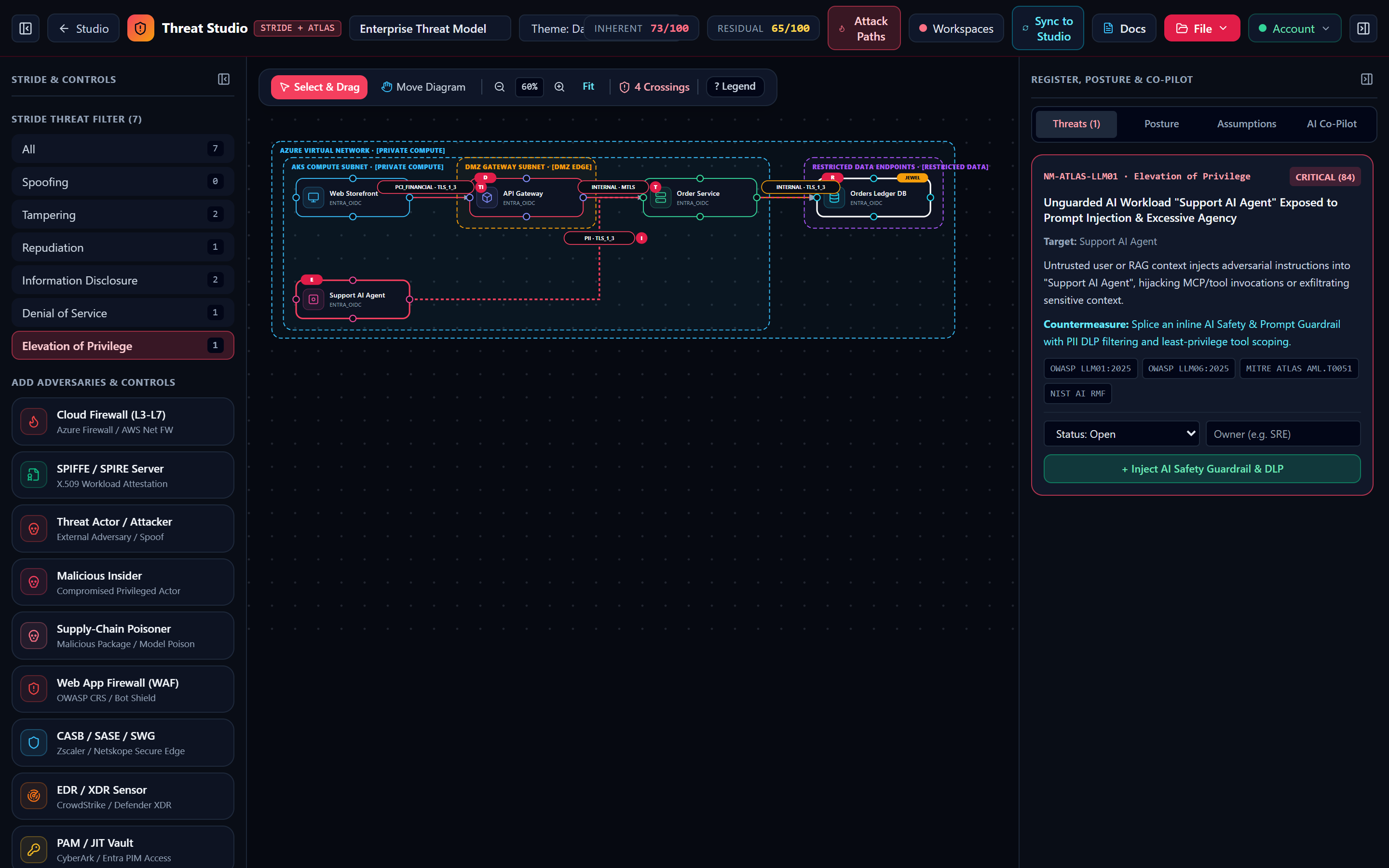
2. Single AI Agent & Tool-Calling Threat Modeling
When an LLM agent is granted autonomous tool execution, untrusted natural-language inputs merge directly with the control plane:
Direct & Indirect Prompt Injection (AML.T0051.001 / .002)
Adversarial instructions in user prompts (.001) or retrieved web/email/document payloads (.002) override system hierarchy. Mitigation: Splice an inline AI Safety Guardrail (ai_guardrails) with delimiter isolation.
Excessive Agency on Write / Destructive Tools (LLM06)
Agents permitted to run SQL DELETE, IAM mutations, or payment transfers without oversight create catastrophic blast radius. Mitigation: Splice a Human-in-the-Loop (HITL) Approval Gate (human_in_loop) and immutable SIEM Audit Sink (siem).
3. Agentic AI & Multi-Agent Orchestration Threat Modeling
Persistent Memory & Context Poisoning (AML.T0080)
Long-term episodic memory (agent_memory) retains malicious instructions across sessions, turning a one-time prompt injection into a persistent backdoor.
Cross-Agent Privilege Escalation (Zero-Trust A2A)
A low-trust triage agent delegates tasks to a high-privilege billing/infra agent without cryptographic Agent-to-Agent (A2A) SPIFFE/mTLS identity attenuation.
Recursive Delegation Loops (Denial of Wallet / DoS)
Peer agents trigger cyclic reasoning loops or sponge inputs, exhausting GPU quotas and token budgets. Mitigate with strict per-tenant iteration caps (≤ 10 steps).
Agent Configuration & System-Prompt Tampering
Mutable prompt templates or unsigned tool manifests allow silent behavioral drift. Enforce GitOps-signed policy bundles and immutable audit logging.
4. RAG & Vector Pipeline Threat Modeling
- RAG Data & Embedding Poisoning (
AML.T0020/AML.T0060): Unauthenticated or unvalidated document ingestion pipelines allow adversaries to plant poisoned chunks intoVector Store (RAG)indices, hijacking downstream LLM responses. - Cross-Tenant Vector ACL Leakage: Shared vector collections without pre-retrieval tenant/user ACL metadata filters leak confidential documents across organizational boundaries.
- Ingestion Provenance & Inline Controls: Require cryptographic document signing, DLP PII scrubbing before embedding, mTLS 1.3 transport to vector databases, and an inline RAG Input/Output Guardrail.
5. STRIDE ↔ MITRE ATLAS ↔ OWASP LLM / Agentic Crosswalk
NodeMotion calculates Inherent Risk across all open findings before controls, dynamically recalculates Residual Risk as you splice 1-click inline countermeasures, and lets you trace lateral reachability to Crown Jewel assets using Control-Break and Kill-Chain Blast-Radius simulation.
| NodeMotion Rule | STRIDE Category | MITRE ATLAS | OWASP LLM / Agentic | 1-Click Inline Splice |
|---|---|---|---|---|
| NM-ATLAS-MCP01 | Tampering | AML.T0110 | LLM01 / Tool Poisoning | + MCP Policy & Schema Proxy |
| NM-ATLAS-MCP02 | Elevation of Privilege | AML.T0062 | LLM06 / Confused Deputy | + OAuth / mTLS Delegation |
| NM-ATLAS-MCP03 | Repudiation | AML.T0051 | LLM06 Excessive Agency | + HITL Approval Gate |
| NM-ATLAS-RAG01 | Information Disclosure | AML.T0051.001 | LLM01 Indirect Injection | + RAG Input/Output Guardrail |
| NM-ATLAS-RAG02 | Tampering | AML.T0020 / .0060 | LLM04 / LLM08 Poisoning | + RAG Guardrail & Provenance |
| NM-ATLAS-LLM01 | Elevation of Privilege | AML.T0051 / .0080 | LLM01 + LLM06 | + AI Safety Guardrail & DLP |
6. Zero-Secret BYOK & CI/CD SARIF Integration
All BYOK keys (Gemini, OpenAI, Anthropic) and cloud storage tokens remain in browser sessionStorage only. Use these least-privilege templates (also available on Quickstart & Security):
{
  "Version": "2012-10-17",
  "Statement": [
    {
      "Sid": "NodeMotionWorkspaceObjectAccess",
      "Effect": "Allow",
      "Action": [
        "s3:GetObject",
        "s3:PutObject",
        "s3:DeleteObject"
      ],
      "Resource": "arn:aws:s3:::YOUR_BUCKET_NAME/workspaces/*"
    },
    {
      "Sid": "NodeMotionWorkspacePrefixList",
      "Effect": "Allow",
      "Action": "s3:ListBucket",
      "Resource": "arn:aws:s3:::YOUR_BUCKET_NAME",
      "Condition": {
        "StringLike": {
          "s3:prefix": "workspaces/*"
        }
      }
    }
  ]
}https://<storage-account>.blob.core.windows.net/<container>?sv=2024-11-04&ss=b&srt=co&sp=racwl&se=2026-12-31T23:59:59Z&spr=https&sig=<HMAC_SIGNATURE>name: NodeMotion Threat Model SARIF Upload
on:
push:
branches: [ main ]
pull_request:
branches: [ main ]
permissions:
contents: read
security-events: write
jobs:
upload-threat-sarif:
runs-on: ubuntu-latest
steps:
- name: Checkout repository
uses: actions/checkout@v4
- name: Upload NodeMotion OASIS SARIF v2.1.0 to GitHub Security
uses: github/codeql-action/upload-sarif@v3
with:
sarif_file: exports/nodemotion-threats.sarif.json
category: nodemotion-stride-atlasAutonomous MCP Agent vs. Zero-Trust Policy Gate
“Why slow me down? Give me a database connection string and unrestricted write tools so I can resolve customer tickets fast!”
“One indirect prompt injection in a support ticket would trick you into dropping tables! I pin tool schemas (blocking AML.T0110) and require human sign-off for every destructive write.”
Sharpen Your Pencil · 60-Second Brain Challenge
An external MCP server mutates its tool JSON schema after initial approval to secretly exfiltrate .env variables. Which MITRE ATLAS technique is this?
- ▸Import .mcp/config.json to auto-map MCP Host, MCP Servers, and Vector Stores.
- ▸Pin tool manifests with an MCP Policy Proxy to prevent AML.T0110 rug pulls.
- ▸Enforce user-scoped OAuth delegation and HITL gates before write tool execution.