Overview & 5-Minute Quickstart
End-to-end tour from Architecture Studio topology design to Threat Studio 1-click mitigation and CISO/SARIF export.
“A threat model that lives in a static slide deck is obsolete the moment someone opens a pull request.”
1. 3-Minute Quickstart: IaC Import, BYOK & First STRIDE + MITRE ATLAS Scan
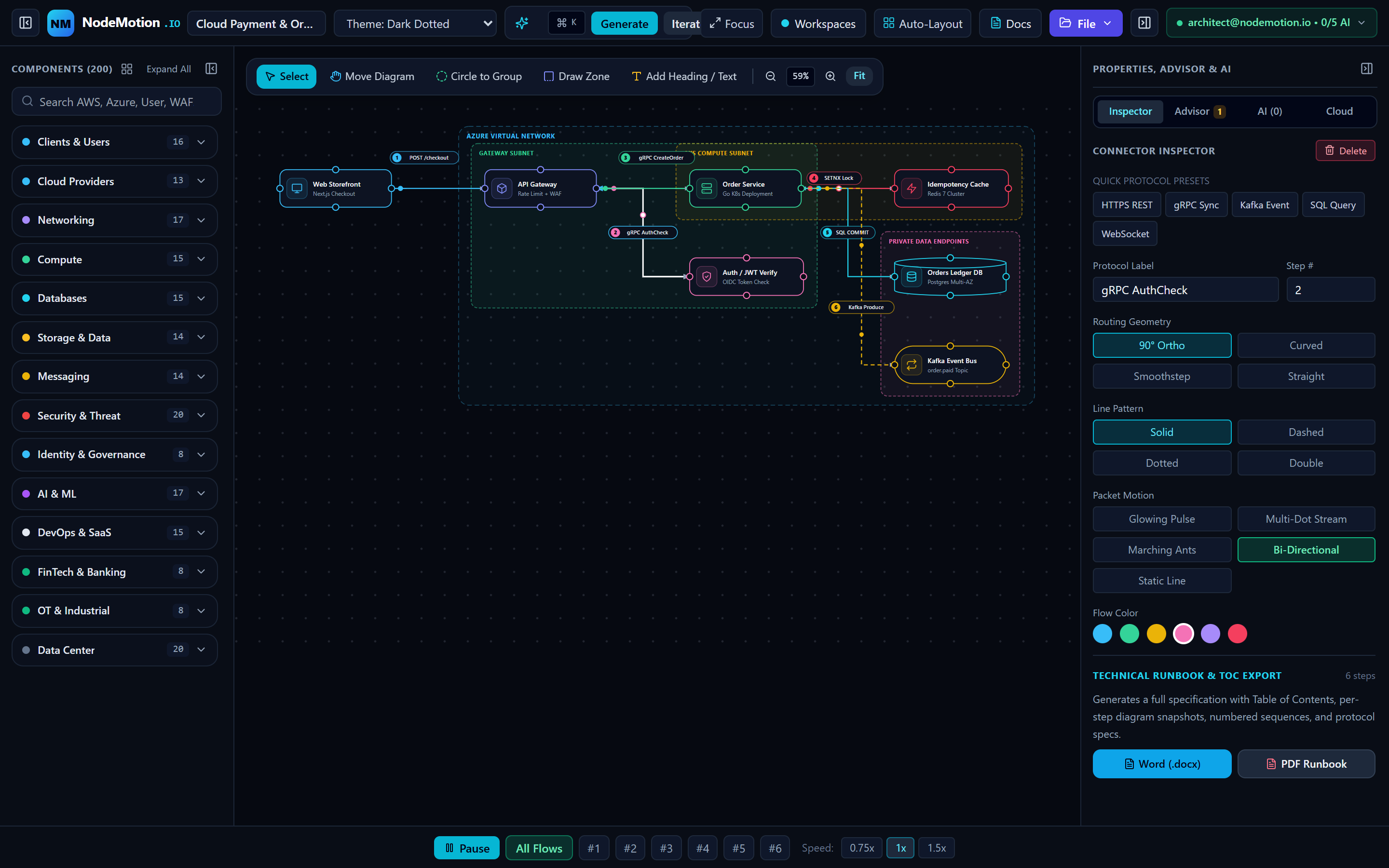
NodeMotion.IO unifies live animated architecture design in Architecture Studio and deterministic threat modeling in Threat Modeling Studio directly inside your browser—keeping your topologies, LLM keys, and cloud storage tokens strictly client-side.
Synthesize Your Topology in Seconds
Open Architecture Studio or Threat Modeling Studio and click File → Import IaC / Spec. Upload a local .tf, .bicep, docker-compose.yml, Kubernetes YAML, or OpenAPI 3.0 spec—or paste a public GitHub repository URL. NodeMotion parses resources into nested VNet/Subnet Trust Boundaries automatically.
Optional AI Co-Pilot & Architecture Synthesis
Click your profile menu → Account & BYOK Settings to enter your own Gemini, OpenAI, or Anthropic API key. Keys are kept exclusively in browser sessionStorage / memory—deterministic STRIDE + MITRE ATLAS scanning works offline with zero AI keys required.
Evaluate Risk, Trace Kill Chains & Export Evidence
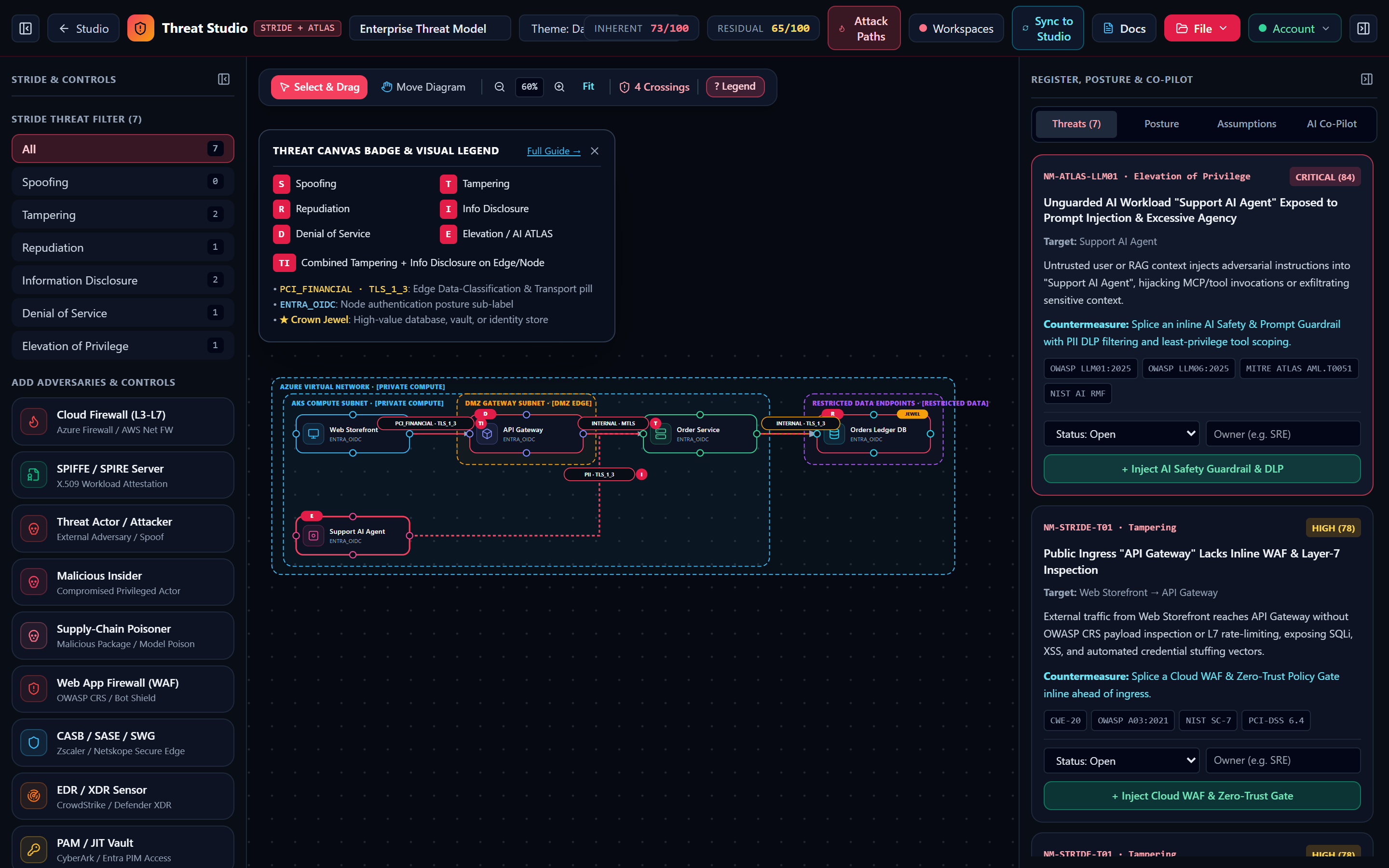
Click Threat Model in Architecture Studio (or open Threat Modeling Studio) to run the < 5ms STRIDE + MITRE ATLAS engine. Inspect red threat badges (S, T, R, I, D, E, TI), run the Kill Chain & Blast Radius simulator, apply 1-click inline countermeasures, and export OASIS SARIF v2.1.0 or a CISO PDF Report.
2. Zero-Secret & BYOK Trust Architecture
User-supplied LLM API keys (Google Gemini, OpenAI, Anthropic) and cloud storage credentials (AWS S3 IAM / Azure Blob SAS) remain strictly inside browser sessionStorage and in-memory state. They are never logged, never persisted to any server-side database, and never transmitted to analytics or telemetry sinks.
Least-Privilege AWS S3 Bucket / IAM Policy (Scoped to workspaces/*)
When connecting your own S3 bucket for encrypted workspace persistence, attach the following least-privilege IAM policy scoped exclusively to the workspaces/* prefix:
{
  "Version": "2012-10-17",
  "Statement": [
    {
      "Sid": "NodeMotionWorkspaceObjectAccess",
      "Effect": "Allow",
      "Action": [
        "s3:GetObject",
        "s3:PutObject",
        "s3:DeleteObject"
      ],
      "Resource": "arn:aws:s3:::YOUR_BUCKET_NAME/workspaces/*"
    },
    {
      "Sid": "NodeMotionWorkspacePrefixList",
      "Effect": "Allow",
      "Action": "s3:ListBucket",
      "Resource": "arn:aws:s3:::YOUR_BUCKET_NAME",
      "Condition": {
        "StringLike": {
          "s3:prefix": "workspaces/*"
        }
      }
    }
  ]
}
Azure Blob Storage SAS Minimum Permissions
For Azure Storage BYOK workspace sync, generate a Container/Service SAS token restricted to HTTPS-only (spr=https), short expiry TTLs (e.g., 1–8 hours), and the minimum permission flags: r (Read), a (Add), c (Create), w (Write), l (List) — omitting Delete (d) or Account Admin permissions where immutable retention is required.
https://<storage-account>.blob.core.windows.net/<container>?sv=2024-11-04&ss=b&srt=co&sp=racwl&se=2026-12-31T23:59:59Z&spr=https&sig=<HMAC_SIGNATURE>3. STRIDE + MITRE ATLAS Scoring & AI/MCP Rule Catalog
Weighted baseline exposure calculated across all open STRIDE, OWASP API, and MITRE ATLAS findings before compensating controls are spliced.
Live recalculated risk after applying 1-click inline countermeasures (Cloud WAF, mTLS X.509, AI Safety Guardrails, SIEM) and triage dispositions.
Toggle Simulate Control Failure or open Kill Chain & Blast Radius to trace lateral pivot paths from any breached node to Crown Jewel assets.
| Rule / Threat Class | MITRE ATLAS / OWASP | Attack Vector | 1-Click / Hardened Control |
|---|---|---|---|
| Direct & Indirect Prompt Injection | AML.T0051 · LLM01 | Untrusted user inputs or external text override system instructions. | Splice AI Safety Guardrail + Delimiter Shield |
| System Prompt & PII Leakage | AML.T0056 · LLM02/07 | Jailbreaks extract hidden instructions, API keys, or memorized PII. | Outbound DLP PII Redaction + Output Schema |
| RAG / Vector DB Poisoning | AML.T0020 · LLM08 | Adversarial chunks injected into knowledge base hijack retrieved context. | Signed Document Provenance + Spotlighting |
| Cross-Tenant Vector Leakage | AML.T0024 · API1 | Shared vector index lacks per-user ACL metadata filtering. | Mandatory Pre-Retrieval Tenant ACL Filter |
| Unauthenticated MCP Servers | AML.T0040 · CWE-306 | Model Context Protocol server exposes tool endpoints without mTLS/OAuth. | Enforce mTLS X.509 + Scoped OAuth Tokens |
| Over-Privileged Agent Tool Execution | AML.T0051.001 · LLM06 | Agent autonomously runs destructive SQL, shell, or payment mutations. | Read-Only Tool Scope + Human-in-the-Loop (HITL) |
4. CI/CD & DevSecOps Integration (OASIS SARIF v2.1.0 & Exports)
Export your Threat Register via File → Export OASIS SARIF v2.1.0 and upload it directly to GitHub Advanced Security Code Scanning using github/codeql-action/upload-sarif@v3:
name: NodeMotion Threat Model SARIF Upload

on:
  push:
    branches: [ main ]
  pull_request:
    branches: [ main ]

permissions:
  contents: read
  security-events: write

jobs:
  upload-threat-sarif:
    runs-on: ubuntu-latest
    steps:
      - name: Checkout repository
        uses: actions/checkout@v4

      - name: Upload NodeMotion OASIS SARIF v2.1.0 to GitHub Security
        uses: github/codeql-action/upload-sarif@v3
        with:
          sarif_file: exports/nodemotion-threats.sarif.json
category: nodemotion-stride-atlasFull schema-compatible DFD export for cross-tool review in desktop or enterprise Threat Dragon pipelines.
Paste-ready diagram definitions for GitHub Pull Requests, Markdown ADR docs, and Confluence pages.
Pre-formatted threat rows with severity, rule ID, target asset, countermeasure, and disposition owner.
Audit-ready runbooks and risk reports with inherent/residual scorecards for ISO 27001, SOC 2, and DORA.
5. Supported IaC Formats & Known Limits
| Format / Spec | Extensions / Input | Supported Constructs & Known Limits |
|---|---|---|
| Terraform HCL | .tf, .tf.json, GitHub URL | AWS/Azure/GCP compute, VNets, subnets, DBs, gateways, IAM. Remote state & encrypted modules require local variable expansion. |
| Azure Bicep | .bicep | Resource declarations, VNets, AKS, Key Vault, APIM, Storage, and symbolic parent references. |
| Docker Compose | docker-compose.yml / .yaml | Services, depends_on wiring, exposed ports, networks, Redis/Postgres/Kafka images. |
| Kubernetes Manifests | .yaml (Multi-doc) | Deployments, Services, Ingress, NetworkPolicy, StatefulSets. Helm templates should be rendered via helm template first. |
| OpenAPI / Swagger | openapi.json / .yaml (v3.x) | Synthesizes API Gateway endpoints, securitySchemes (OAuth2/OIDC/API Key), and downstream backend paths. |
6. Complete 9-Module Documentation Directory
End-to-end tour from Architecture Studio topology design to Threat Studio 1-click mitigation and CISO/SARIF export.
Deterministic orthogonal routing, nested trust zones, step-by-step packet playback, Well-Architected Advisor, Aesthetic Backdrop Switcher, and Word/PDF runbooks.
Decode every red STRIDE/ATLAS badge, dashed Trust Boundary, transport & sensitivity pill, identity label, and Crown Jewel marker on the canvas.
How live STRIDE Threat Filter counters work and full reference guide for all 10 Adversaries & Security Controls in the Threat Studio palette.
Anatomy of a Threat Register card (NM-STRIDE-T01, CWE/OWASP/NIST/PCI-DSS badges, 1-click inline mitigation), Posture Inspector, Control-Break Simulator, Assumptions, and AI Co-Pilot.
Real-world workflows for Attack Paths, Workspaces, Sync to Studio, CISO STRIDE Report (PDF), Threat Register CSV, OWASP Threat Dragon v2, OASIS SARIF v2.1.0, and .nodemotion.json.
How NodeMotion models LLMs, vector stores, and MCP tool-calling agents under STRIDE + MITRE ATLAS (NM-ATLAS-LLM01), and how AI Safety Guardrail & DLP mitigate prompt injection.
Supported formats (.tf, .bicep, docker-compose.yaml, OpenAPI, Kubernetes YAML), GitHub tree discovery rules, and 1-click downloadable starter templates.
Honest What is There vs. What is Not matrix, BYOK privacy lifecycle (Gemini, OpenAI, Anthropic), Zero-Secret S3/Azure SAS cloud workspaces, and GitHub Actions SARIF pipelines.
There Are No Dumb Questions
Candid answers to the skeptical questions every security engineer asks first.
Sharpen Your Pencil · 60-Second Brain Challenge
You import a Terraform file with a public PostgreSQL server (public_network_access_enabled = true) and no WAF. Which action drops Residual Risk fastest?
- ▸Start from Architecture Studio, a Reference Blueprint, or File → Import IaC / Spec.
- ▸Handoff to Threat Modeling Studio in 1 click to score Inherent vs. Residual Risk.
- ▸Splice inline controls and export OASIS SARIF v2.1.0 or CISO PDF evidence.